
Portfolio · Fashion
ArchivoRebuilding a Founder's Vision Into a Real Product
A working stylist taught himself to build Archivo alone, then brought Rootstrap in to turn a working demo into a product his business could actually run on. Full audit, rebuild, and App Store launch, with Claude powering the two AI-driven features at the core of the app.
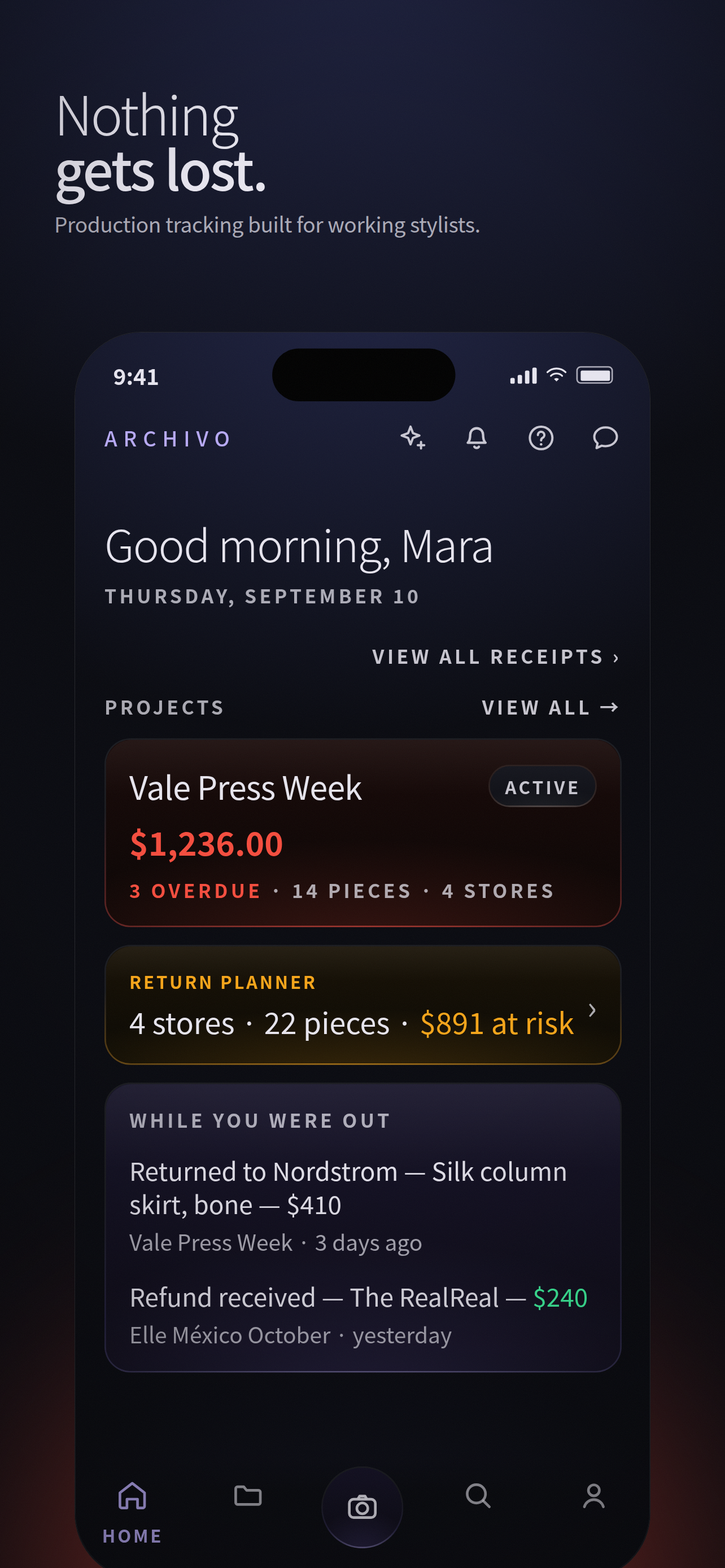
A stylist who works fashion week and major brands had an idea for how his industry should run, and he'd already proven it himself, teaching himself just enough to build a working version alone. Rootstrap came in to take that vision the rest of the way: from something that worked in a demo to something that could carry his business.
About Archivo
Archivo helps stylists manage the parts of the job nobody sees: tracking receipts, chasing down returns on borrowed garments, putting together wrap reports for agencies and clients when a project wraps, all backed by an in-app AI assistant. The founder built the first version himself with AI no-code tools (Lovable, Cursor, Supabase, Capgo), enough to prove the idea was real, but not enough to run on.
Powered by Claude
Two distinct uses of Claude sit at the core of the product. Haiku handles multimodal structured data extraction, parsing photos and PDFs of receipts and rental agreements into structured records. Sonnet powers Arco, the in-app conversational assistant, with live tool access to the application database so users can query and act on their own data in natural language.
Starting With Intent, Not Assumptions
Before touching the code, Rootstrap sat down with what the founder actually wanted the product to become, and audited what had actually been built against it. The gap was real: working features sat on a foundation with no safety net.
- Type-checking was disabled across the entire codebase
- Automated test coverage was effectively zero
- Deployment ran through a single script, executed by hand, with no staging environment behind it
Getting the Ground Truth Right
That audit became the reference point for everything after. Rather than guess at what "done" meant, Rootstrap built a living, human-reviewed record of what the client had actually asked for and approved, keeping current as requirements shifted.
- Used it to sequence the rebuild itself: foundation first, features second
- Required every AI agent in the delivery pipeline, QA included, to check against it before acting
- Used it to catch a real case where a legitimate client-requested change had been misflagged as a regression
Building It Back Up
With that ground truth in place, the team rebuilt the engineering foundation, then layered in what the prototype never had.
- Installed a CI/CD pipeline and a staging environment
- Brought strict typing and test coverage to the app's most critical paths
- Closed the security gaps the audit had surfaced
- Delivered payments integration, shipping, database-enforced role permissions, and GDPR/CCPA compliance readiness
Verifying It Held
The AI QA layer checked its own work against that same ground truth before flagging anything as broken, catching the difference between an actual regression and a decision the client had already made. It's a small thing that mattered: it kept the team from chasing bugs that weren't bugs, and kept the QA process itself trustworthy at production speed rather than just fast.
What It Proved Out
A stable, working baseline came together in the first three weeks of a ten-week first phase, built on a foundation that could actually hold new features without breaking. The client trusted the rebuild enough to bring Rootstrap a second phase, and a new line of business, before that first phase had even wrapped.
Outcomes
- False-positive QA regressions eliminated
- Full commercial and compliance layer delivered: payments, shipping, database-enforced roles, GDPR/CCPA, App Store readiness
- Engineering foundation built from zero: CI/CD, staging, test coverage on critical paths
- Critical security gaps closed ahead of launch
- Two-model Claude architecture built into core product functionality, not just backend tooling